
There's a wave coming. Not a gentle swell, but a tsunami—vast, fast, and indifferent to your readiness. AI has arrived. It's reshaping jobs, dissolving traditional roles, and redefining work itself. The only question: do you surf, or do you stand on the shore hoping it passes?
Hope is not a strategy.
This Is Not an IT Project
Let me say something that might surprise you, coming from someone who spent years in head offices of the major international technology companies: AI transformation is fundamentally a human resources challenge, not a technology challenge.
IT provisions the infrastructure. IT brings the expertise and configures the platforms. But the truly difficult questions—who does what work, which roles evolve, which disappear, how we retrain thousands of people, how we redesign teams, how we maintain culture and morale through seismic change—those are squarely HR questions. They always have been.
Yet in too many boardrooms, AI is still treated as a technology initiative. That framing is dangerous. It means the people implications—the hardest, most consequential, most strategically important implications—get bolted on as an afterthought. By the time HR is invited into the room, the architecture has been decided and the human fallout is already in motion.
If your organisation is approaching AI this way, you are building a house starting with the roof.
The Hub-Bot Work Spectrum: A Way to Think About What's Changing
One of the frameworks I use with leadership teams is the Hub-Bot Work Spectrum, a six-level model for understanding where any function, team, or process sits on the continuum between fully human and fully automated work:
At Level 1, work is entirely human. At Level 2, humans lead but bots handle specific, exceptional tasks. Levels 3 and 4 represent genuine human-bot co-working—first on different tasks, then increasingly on the same tasks. At Level 5, bots lead and humans intervene only for exceptions. Level 6 is full automation.
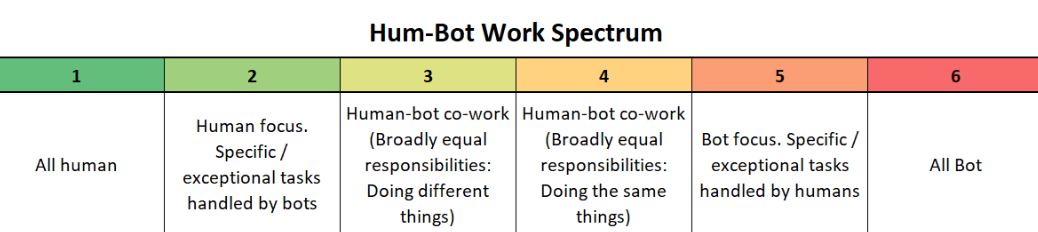
The point is not that every function should race to Level 6. The point is that every function will move along this spectrum, and leaders need to make deliberate, informed decisions about where each part of their organisation should sit—and how fast to get there.
Those decisions require evaluating multiple factors: technical feasibility, cost-benefit realities, strategic competitive pressure, skills and training practicalities, ethical considerations, customer experience, regulatory constraints, and workforce relations. Get the balance wrong and you either move too slowly and lose competitive ground, or move too recklessly and destroy capability, trust, and culture.
This is workforce design. This is organisational development. This is, by definition, HR's territory.
The People Risks Are Real—and They're Urgent
None of these risks are theoretical. They are playing out right now, in every sector, in every geography. Here in the UAE, the pace is extraordinary—the UAE has positioned itself as a global leader in AI adoption, and organisations that hesitate are watching competitors pull away in real time.
The Opportunities Are Equally Real
But here's why I use the word "surfing" and not "surviving." Managed well, AI transformation doesn't just mitigate risk—it unlocks genuine competitive advantage.
Processes become faster. Decision-making becomes sharper and more data-driven. Error rates plummet. Customer experience improves as routine queries are handled instantly and human attention is freed for complex, high-value interactions. Operational costs reduce—not through crude headcount cuts, but through intelligent redesign of how work gets done.
The organisations getting this right are not the ones throwing AI at every problem. They are the ones starting with great problems first—using disciplined approaches like Lean Six Sigma and Design Thinking to identify where the real pain points, inefficiencies, and opportunities lie, and then applying AI where it delivers genuine return on investment. Problem-driven, not tech-led. That distinction matters enormously, and it's the difference between transformation that sticks and expensive experimentation that doesn't.
Why I'm Writing This
I've spent my career at the intersection of technology, process excellence, and people. As a former HR Director and Chief Talent Officer at leading global technology organisations, I've led large-scale transformation programmes delivering multi-million, double-digit ROI. Across the UK, Europe, Asia, the Americas and the Middle East, I've enabled thousands of professionals through enterprise-wide capability building in AI, Lean Six Sigma, Agile and Design Thinking.
I've gained deep insight into what works, what fails, and why.
What I've learned is that the organisations which thrive through disruption are not necessarily the ones with the biggest technology budgets. They are the ones that treat transformation as a human challenge first—that invest in their people's ability to adapt, that redesign work thoughtfully, and that lead with clarity and honesty about what's changing and why.
What Comes Next
This post is the first in a series. In the posts that follow, I'll share the practical tools, frameworks, and methods I've developed and refined over years of leading transformation at scale—approaches that address both the risks and the opportunities of AI head-on. From strategic workforce planning models to ethical decision frameworks, from retraining strategies to organisational redesign playbooks, these are battle-tested approaches built for the real world, not limited to conference stage.
The tsunami is here. The board is in front of you.
I'd suggest you start paddling.
Back to articles ←
Author

Jagrity Singh
Dynamic Strategist and Proven Implementer with extensive experience in designing and executing people, , and operational frameworks which shape both the present and future of organisational talent. Skilled in partnering across multiple businesses and geographies, with a strong track record in managing key stakeholder relationships, including CXOs. A core focus on HR partnering within group functions, implementing global talent development strategies, and overseeing comprehensive HR operations (both downstream and upstream).
Successfully developed a Talent Intelligence framework which aligns with organisational purpose and values, fostering internal talent growth, inclusivity, mobility, and robust succession planning. Known for driving impactful strategies which enhance workforce development and organizational success.
Turn AI Insight into HR Impact
Advance Your Career with AI in HR Certification
-
Artificial Intelligence in HR Certification (AIHR-C)
BundleMaster the future of HR with the AI in HR Certification (AIHR-C). Learn to apply AI tools in recruitment, learning, and people analytics through hands-on practice and real-world applications. Transform HR processes with cutting-edge AI skills.
Purchase$199