
Over the past year, I have increasingly noticed organisations, technology vendors, consultants, and HR practitioners using phrases such as "AI + HR" and "AI × HR" to describe their products, services, transformation programmes, and visions for the future of work. These expressions appear frequently in conference themes, marketing campaigns, industry reports, boardroom presentations, and social media discussions. They are often presented as self-explanatory concepts that capture the relationship between Artificial Intelligence and Human Resources. The more I encountered these phrases, the more I found myself questioning what they actually mean.
At first glance, the distinction appears insignificant. However, symbols often reveal assumptions that words fail to capture. The growing body of research on artificial intelligence and human resource management suggests that how organisations conceptualise the relationship between technology and people has important implications for organisational strategy, capability development, Leadership, governance, and value creation (Minbaeva, 2021; Vrontis et al., 2022; Haidari & Chhibber, 2022). The question is therefore not simply whether AI and HR can work together. The more important question is whether these expressions represent fundamentally different assumptions about how organisations create value in an increasingly AI-enabled world.
More importantly, I have come to believe that the debate itself may be too narrow. The real issue is not whether HR adopts AI. The real issue is whether HR is prepared to redefine its contribution in a business environment where intelligence is becoming increasingly accessible, automated, and commoditised. In such a world, the future relevance of HR may depend less on its activities and more on the value it creates for employees, customers, investors, regulators, and society. This shift in thinking reflects a broader movement within the HR profession away from process excellence alone and towards stakeholder value creation as the ultimate measure of success (Nyberg et al., 2026).
The Growing Role of Artificial Intelligence in Human Resources
The integration of artificial intelligence into HR functions has accelerated rapidly over the last decade. Organisations are increasingly deploying AI-enabled technologies across recruitment, workforce planning, learning and development, employee engagement, performance management, employee services, and workforce analytics. Recent research consistently reports improvements in efficiency, speed, scalability, and data-driven decision-making through the application of AI across these domains (Margherita, 2022; Chowdhury et al., 2023; Haidari & Chhibber, 2022). Tasks that previously required substantial administrative effort can now be automated, while large volumes of workforce data can be analysed in real time to generate insights that were previously difficult or impossible to obtain.
The literature is remarkably consistent in highlighting these benefits. AI can screen resumes faster, identify workforce trends more accurately, personalise employee learning pathways, improve workforce planning, and support evidence-based decision-making. Yet despite the enthusiasm surrounding these developments, one conclusion repeatedly emerges across studies conducted in different industries, countries, and organisational contexts. Artificial intelligence is increasingly viewed as a complement to human resource professionals rather than a replacement for them, particularly in areas requiring judgement, contextual interpretation, ethical reasoning, and relationship management (Vrontis et al., 2022; Haidari & Chhibber, 2022). While AI excels at processing information, identifying patterns, and automating routine activities, functions involving empathy, trust-building, conflict resolution, leadership influence, and organisational sense-making continue to depend heavily on human capability.
This recurring finding is significant because it challenges the popular narrative that AI will eventually replace HR professionals. The evidence increasingly suggests that the future of HR is not a contest between humans and machines. Rather, it is a question of how technology and human capability can work together to create organisational value. However, understanding the nature of that relationship requires us to examine the assumptions hidden behind the language we use.
The Hidden Assumptions Behind AI + HR
The phrase "AI + HR" reflects a particular philosophy of organisational change. The addition symbol suggests that AI can be incorporated into existing HR processes to improve efficiency and effectiveness. Under this perspective, HR remains fundamentally unchanged while AI serves as a supporting technology that enhances existing activities. Recruitment becomes faster. Learning becomes more personalised. Employee services become more responsive. Performance management becomes more data-driven. The underlying operating model remains largely intact while technology improves its execution.
There is considerable value in this perspective. For many organisations, incremental adoption represents the most practical path towards building AI capability. It allows organisations to generate quick wins, demonstrate measurable benefits, and build confidence in new technologies without introducing excessive disruption. In many respects, this mirrors previous waves of digital transformation, in which organisations gradually integrated Human Resource Information Systems, workforce analytics platforms, and employee experience technologies into existing operating models.
However, the AI + HR perspective also carries an important assumption that deserves closer examination. It assumes that the existing work structure remains largely appropriate and that technology enables existing processes to operate more efficiently. This assumption may be increasingly problematic. Throughout business history, organisations have repeatedly demonstrated that automating inefficient processes does not necessarily improve organisational effectiveness. In many cases, it simply enables organisations to perform outdated activities more quickly. Process improvement creates value when the underlying process remains relevant. It creates less value when the nature of work itself is changing.
This focus on process optimisation reflects a broader pattern identified in digital transformation research, where organisations frequently prioritise technology adoption and efficiency gains while underestimating the organisational and behavioural changes required to realise sustainable value (Minbaeva, 2021; Alnuaimi et al., 2022). The distinction becomes particularly important when viewed through the lens of stakeholder value. Organisations do not compete solely on the quality of their HR processes. They compete on their ability to create value for customers, investors, employees, regulators, and society. Consequently, improving HR processes should not be mistaken for improving organisational capability. The two are related, but they are not the same.
Why AI × HR Represents a Different Way of Thinking
The multiplication symbol introduces a fundamentally different perspective. Unlike addition, multiplication implies interaction, dependency, and amplification. Under an AI × HR model, organisational outcomes are determined not only by the quality of the technology but also by the quality of the human systems surrounding it. The effectiveness of AI becomes inseparable from leadership capability, organisational culture, employee trust, workforce readiness, governance mechanisms, and strategic clarity.
Viewed through this lens, AI is no longer simply a tool that HR uses. Instead, AI becomes a catalyst that forces organisations to reconsider how work is organised, how decisions are made, how authority is distributed, and how capabilities are developed. The conversation shifts away from automation and towards organisational redesign. This shift aligns with emerging research suggesting that the value of AI is determined less by technological sophistication and more by an organisation's ability to redesign work, develop new capabilities, and integrate human and machine intelligence effectively (Chowdhury et al., 2023; Yablonsky, 2024).
Questions surrounding workforce architecture, skills-based talent systems, human-AI collaboration, algorithmic governance, decision accountability, and organisational adaptability become increasingly important. This perspective aligns closely with a growing recognition within management research that sustainable competitive advantage rarely emerges from technology alone. Instead, advantage emerges from organisational capabilities that competitors struggle to replicate. Adaptability, learning agility, collaboration, innovation, Trust, resilience, and responsible governance increasingly become strategic assets. Artificial intelligence may accelerate work, but it does not automatically create these capabilities. The challenge, therefore, shifts from deploying technology to building organisations capable of translating technology into meaningful stakeholder value. This perspective is increasingly supported by studies demonstrating that leadership capability, organisational agility, learning culture, and workforce readiness play critical roles in determining the success of AI-enabled transformation initiatives (Alnuaimi et al., 2022; Korzynski et al., 2025).
Why Organisational Capability Matters More Than Technology
One of the most consistent findings within contemporary HR and management research is that technology alone rarely creates sustainable competitive advantage. Organisations operating within the same industry often have access to similar technologies, yet their performance outcomes vary significantly. The difference frequently lies not in the technology itself, but in how effectively organisations align technology with Leadership, culture, governance, and workforce capability.
This observation is particularly relevant in the context of AI adoption. A sophisticated AI platform deployed within a low-trust organisation characterised by weak Leadership and poor capability development is unlikely to generate meaningful value. In some cases, it may even amplify existing dysfunctions by increasing employee resistance, reinforcing poor decision-making, or creating new governance risks. Conversely, organisations with strong learning cultures, effective Leadership, high levels of Trust, and robust governance mechanisms often generate exceptional value from relatively modest technological investments.
The implication is reflective and supported by recent evidence. As AI technologies become more accessible and widely available, organisational capability becomes a more significant differentiator than technology itself (Chowdhury et al., 2023; Korzynski et al., 2025). Research suggests that organisations gain greater value from AI when Leadership, culture, governance, and workforce capabilities evolve alongside technological investments rather than lag behind them (Yablonsky, 2024; Haidari & Chhibber, 2022). The future advantage, therefore, belongs not to organisations with the most advanced AI, but to organisations with the strongest capability to convert AI into stakeholder value.
The Emerging Scarcity of Judgment, Trust, and Accountability
For the better part of the past 20 years, exclusive access to data has been a primary driver of competitive advantage. Today, generative AI is rapidly changing that reality. Information, analysis, content generation, and even certain forms of expertise are becoming increasingly abundant. As a result, the nature of scarcity is beginning to shift.
What remains scarce is the capability to interpret, challenge, and apply information responsibly. Recent research increasingly points to human judgement, critical thinking, Trust, and governance as strategic capabilities that become increasingly important as AI systems become more capable and pervasive within organisations (Korzynski et al., 2025; Yablonsky, 2024). Human judgment is becoming more, rather than less, important. Trust is becoming more, rather than less, important. Accountability is becoming more, rather than less, important. Ironically, the widespread adoption of AI may increase the strategic value of uniquely human capabilities rather than diminish them.
The ultimate challenge, therefore, is not whether AI can make decisions faster. The challenge is whether stakeholders continue to trust those decisions. Employees must trust that AI-enabled processes are fair. Customers must trust that organisational decisions remain responsible. Regulators must trust that appropriate controls remain in place. Investors must trust that governance keeps pace with technological capability. Trust increasingly serves as a strategic asset shaping stakeholder acceptance, technology adoption, and organisational legitimacy in AI-enabled environments (Nyberg et al., 2026; Yablonsky, 2024).
This reality places new responsibilities on HR leaders. Their role extends beyond technology implementation. They must help organisations establish governance mechanisms, clarify accountability structures, develop AI literacy, strengthen critical thinking, and create environments where employees feel confident challenging AI-generated outputs when necessary. In other words, the future of HR may depend less on its ability to implement AI technologies and more on its ability to create systems that ensure those technologies are used wisely.
Beyond AI + HR and AI × HR: A Systemic Equation
While the distinction between AI + HR and AI × HR offers a useful starting point, both perspectives may ultimately be incomplete. The growing complexity of modern organisations suggests that organisational performance cannot be explained solely by the relationship between technology and human resources. Leadership quality, organisational culture, Trust, governance, and capability development all exert profound influence over transformation outcomes.
To capture this complexity, I believe we must move beyond simple pairings and look at the entire ecosystem. A more realistic framework can be expressed through a systemic, interactive equation:
Organisational Value = AI x Organisational Capability x Trust x Leadership x Accountability
This formulation establishes that each element functions as a critical multiplier rather than an independent, additive contributor. Because the relationship is multiplicative, the compounding impact of a weakness in any single area is severe. Mathematically, if Trust collapses and approaches zero, the entire equation cascades toward zero, regardless of how advanced the AI technology is.
- If Trust collapses, employee adoption fails, and resistance grows.
- If Organisational Capability (the enterprise's systemic architecture, agility, and structures) is weak, implementation stalls.
- If Accountability is unclear, serious governance and compliance risks emerge.
- If Leadership lacks vision and direction, the digital transformation loses all momentum.
The Operational Shift in Practice
To understand what this equation requires of HR leaders, we must examine how everyday HR initiatives transform when moving from a traditional, additive approach to a multiplicative, systemic mindset:
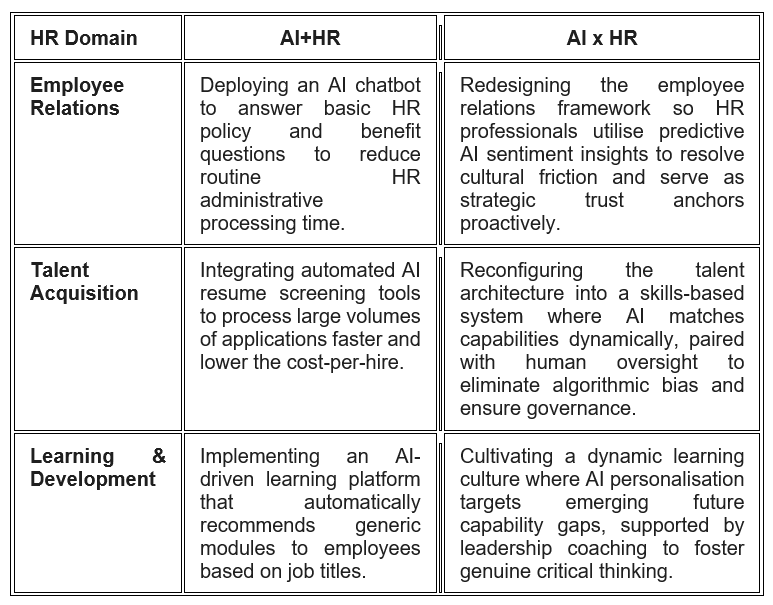
This formulation reflects a growing body of evidence suggesting that organisational performance emerges from the interaction between technological capability, leadership effectiveness, workforce readiness, governance quality, and stakeholder trust rather than from technology adoption alone (Chowdhury et al., 2023; Haidari & Chhibber, 2022; Korzynski et al., 2025). It shifts the conversation away from technology implementation and towards value creation. Most importantly, it challenges HR leaders to think beyond efficiency gains and ask a more fundamental question:
How does AI help the organisation create greater value for its stakeholders?
Conclusion: The Real Question Facing Human Resources
The growing popularity of phrases such as "AI + HR" and "AI × HR" reflects an important conversation about the future of work. However, these expressions also risk oversimplifying a much more complex reality. The evidence emerging from both academic research and organisational practice suggests that artificial intelligence is unlikely to replace human resource management. Rather, it is reshaping the environment within which HR operates and forcing organisations to reconsider how work, Leadership, capability, and Accountability should be organised.
The most important question, therefore, is not whether HR adopts AI. Nor is it whether AI replaces HR. The more significant question is whether HR can help organisations convert technological capability into stakeholder value. This perspective aligns closely with recent thinking that the future relevance of HR should be assessed not by the sophistication of its practices but by the value it creates for employees, customers, investors, regulators, and society (Nyberg et al., 2026).
In an age where intelligence is becoming increasingly abundant, the future relevance of HR may ultimately be determined by its ability to cultivate what remains scarce. Judgment. Trust. Accountability. Learning. Adaptability. These are not merely human qualities; they are vital organisational capabilities. The organisations that thrive in the age of AI will not necessarily be those with the most advanced technologies. Rather, they will be those that successfully combine AI capability with Leadership, Trust, organisational agility, governance discipline, and human judgement to create sustainable stakeholder value (Alnuaimi et al., 2022; Korzynski et al., 2025; Nyberg et al., 2026).
References
Alnuaimi, B. K., Singh, S. K., Ren, S., Budhwar, P., & Vorobyev, D. (2022). Mastering digital transformation: The nexus between Leadership, agility, and digital strategy. Journal of Business Research, 145, 636-648.
Chowdhury, S., Dey, P., Joel-Edgar, S., Bhattacharya, S., Rodriguez-Espindola, O., Abadie, A., & Truong, L. (2023). Unlocking the value of artificial intelligence in human resource management through AI capability framework. Human Resource Management Review, 33(1), 100899.
Haidari, M., & Chhibber, P. (2022). Artificial intelligence and human resource management: A conceptual framework. In Innovations in finance, business processes and technology during crisis. Weser Books.
Margherita, A. (2022). Human resources analytics: A systematisation of research topics and directions for future research. Human Resource Management Review, 32(2), 100795.
Minbaeva, D. (2021). Disrupted HR? Human resource management in the digital age. Human Resource Management Review, 31(1), 100820.
Nyberg, A. J., Kehoe, R. R., Ulrich, D., & Wright, P. M. (Eds.). (2026). The age of HR: Delivering stakeholder value through strategic organisational capability: Talent, Leadership, and culture. Center for Executive Succession, Darla Moore School of Business, University of South Carolina; ILR School, Cornell University; The RBL Group.
Vrontis, D., Christofi, M., Pereira, V., Tarba, S., Makrides, A., & Trichina, E. (2022). Artificial intelligence, robotics, advanced technologies and human resource management: A systematic review. International Journal of Human Resource Management, 33(6), 1237-1266.
Yablonsky, S. (2024). Multi-dimensional framework for digital platform ecosystem governance. International Journal of Information Management, (Forthcoming).
Korzynski, P., Mazurek, G., & Krzypkowska, P. (2025). Artificial intelligence leadership: Conceptualising leadership capabilities in the AI-driven era. Technological Forecasting and Social Change, 201, 123214.
Instructor(s)
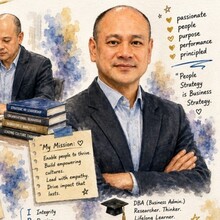
Dr.Kua Kee Tui
Dr. Kua Kee Tui is the Head of Human Resources at Mizuho Bank (Malaysia) Berhad and a certified Human Resources Strategist (HRS), Senior Professional in Human Resources – International (SPHRi), and Fellow of the Malaysian Institute of Management (FMIM). With over 26 years of regional and international HR leadership experience, he has led transformative people strategies across financial institutions and multinational corporations, including Maybank, the National Bank of Abu Dhabi, Genting Berhad, Valspar, Focus Point, etc. At Mizuho, Dr. Kua pioneered award-winning initiatives in hybrid working and HR communication, earning back-to-back accolades at the Human Resources Excellence Awards in 2023, 2024 and 2025.
Renowned for his employee-centric philosophy, Dr. Kua promotes authentic leadership, an inclusive workplace culture, and agile HR governance. He is a recognised thought leader on reimagining internal communication and enabling future-ready talent. He regularly advises executive leadership teams and boards on strategic workforce planning, post-merger integration, succession, and regulatory HR alignment.
Dr. Kua holds a Doctor of Business Administration (DBA) from HELP University, where his research focused on job satisfaction, person-environment fit, and turnover intention in early-career bankers in the banking industry. He also earned a Master of Business Administration (MBA) in Strategic Management from the University of Technology Malaysia, supported by Human Development degrees and a Computer Science diploma from the University Putra Malaysia. This multidisciplinary academic foundation equips him with deep insight into human behaviour and technology application -an ideal blend for modern HR leadership.
Beyond academia and corporate practice, Dr. Kua underwent formal military leadership training and was commissioned as a Second Lieutenant in the Rejimen Askar Wataniah, the Malaysian Army Reserve Force. This experience strengthened his discipline, command presence, crisis response capability, and structured decision-making under pressure. The combination of strategic management scholarship, behavioural research expertise, technological literacy, and military leadership training positions him uniquely at the intersection of governance, people strategy, and organisational resilience.
He actively mentors emerging professionals through the FutureLab mentoring programme, supporting the development of future talent and leadership capability. He also contributes to academia as an External Examiner with HELP University.
Turn AI Insight into HR Impact
Advance Your Career with AI in HR Certification
-
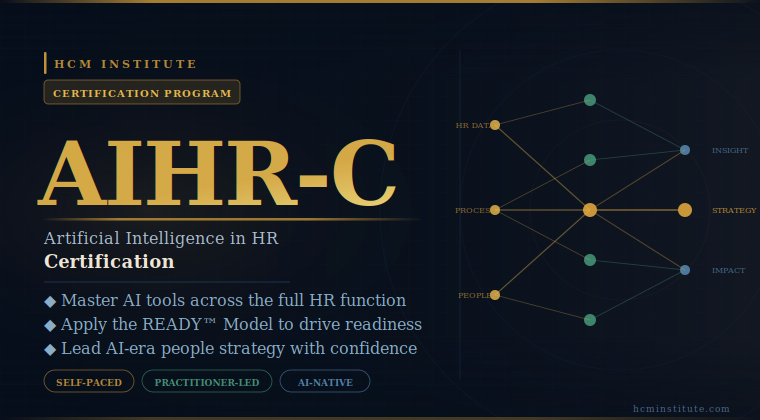
Artificial Intelligence in HR Certification (AIHR-C)
BundleMaster the future of HR with the AI in HR Certification (AIHR-C). Learn to apply AI tools in recruitment, learning, and people analytics through hands-on practice and real-world applications. Transform HR processes with cutting-edge AI skills.
Purchase$199