
Do you remember when computers first started infiltrating offices? People were then divided into two camps: those who learned to harness the tool to their advantage, and those who clung to paper and pen until time left them behind. This fundamental rule hasn't changed, and it applies to all of us today.
With over 12 years of experience in Human Resources, and driven by my passion for technology—which led me to deeply study AI tools and complete specialized courses in their applications—I believe we are facing a golden opportunity. Therefore, I will begin a "Practical Guide" series with you to navigate this evolution, starting with situations we encounter daily:
1. CV Screening (ATS): Why Do You Receive a Rejection Email Before Even Closing Your Laptop?
Almost all of us have received that infamous "Thank you for your interest..." rejection email to the point where we recognize its preview in notifications and delete it without opening! According to Jobscan, 75% of resumes are discarded by ATS systems before an HR professional ever sees them.
- The Problem: People often prioritize complex designs and colors, which can make the ATS "blind" to your actual experience.
- Expert Tip: Your skills aren't enough if they don't reach us. Use keywords directly from the Job Description to ensure your resume gets "seen."
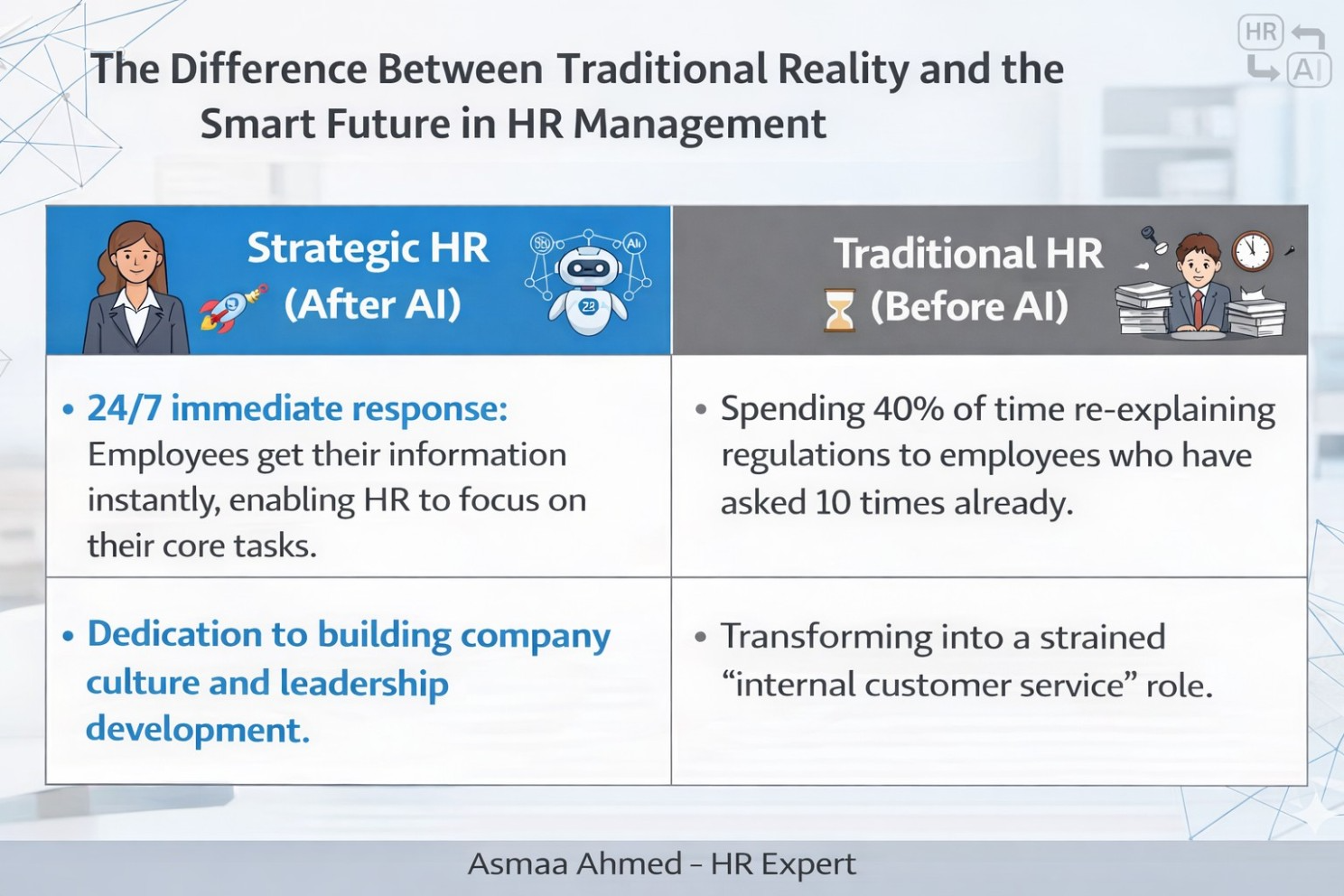
2. Automating Inquiries (The HR Chatbot): Goodbye to the "Customer Service" Role
As HR professionals, our time often gets consumed answering the same repetitive questions: "How many vacation days do I have?" "How do I request an advance?" Ironically, some employees might ask, "When will my salary be paid?" (even though it's on the same date every month!), or "Where can I get the insurance document?"—asking the same questions monthly as if they just started yesterday!
A McKinsey report indicates that 56% of HR tasks can be automated. This means a "smart assistant" or chatbot can fully manage these inquiries, freeing HR to focus on building true strategic initiatives.
3. Performance Analysis (Data vs. Empathy): Data for Insight, Heart for Humanity
At a time when employee assessments were sometimes subject to personal biases, AI has entered to transform the game. Numbers don't flatter, and data is now more accurate and objective than ever before. World Economic Forum research shows that companies using AI analytics in performance evaluations have seen a 20% increase in "assessment fairness."
"However, this is where your role as an HR Leader truly shines: AI is limited to the 'tangible.' It will tell you what happened based on data, but it can never understand why it happened; especially if the reason is purely human and unrelated to numbers, such as burnout, workplace stress, or an employee feeling undervalued."
- The Smart Tool: Detects declines and analyzes data with precision and objectivity.
- The Human Leader: Engages with the employee, understands if there's burnout, sudden personal circumstances, or even a lack of team cohesion.
- A Shared Vision: AI acts as the 'thermometer' that signals a problem, but we, as humans, are the 'doctors' who diagnose and treat the situation with the spirit of the law, not just its rigid letter.
4. Professional Integrity & Data Privacy (Ethics & Privacy)
Beyond numbers and tools, our ethical commitment remains the cornerstone of our work. In Human Resources, we are not just data managers; we are custodians of the privacy and secrets of every employee within the organization.
With the World Economic Forum forecasting the creation of 97 million new AI-related jobs, our role as the company's "moral compass" becomes even more critical. AI is an incredibly smart tool, and we are the ones who guide it to serve humanity. Remember, however, that it lacks a conscience and does not grasp the meaning of integrity.
Herein lies our role to ensure:
- Digital Justice: Algorithms do not show bias against anyone.
- Privacy Protection: Employee data remains completely secure and is used solely for their benefit.
Ultimately, we are the ones who ensure that technology works for human benefit and with the utmost integrity, not against it.
Conclusion: The real transformation isn't in the tool itself, but in your mindset—how you choose to use it.
My question to you: Whether you are in HR or another field, what "routine" task do you wish to delegate to Artificial Intelligence so you can focus on creativity in your work?
Author

Asmaa Ahmed
A People & Culture-focused HR Leader with 10+ years of experience building and leading HR functions across diverse industries in Egypt, India, and the GCC.
I’ve worked across Oil & Gas, FinTech, Banking, Education, Project Development, and Financial Audit, which gave me strong business insight and a high level of adaptability to different business environments and leadership styles.
My expertise spans the full HR spectrum:
Talent Acquisition & Talent Management • OD & Performance • Learning & Development • Employee Engagement • Compensation & Benefits • ER & Policies • HR Strategy & Data Analytics.
I hold an MBA and a People & Organization Development Certificate from AUC. I am passionate about modern, people-centered HR practices, leveraging AI and data-driven tools to drive transformation, building healthy cultures, and supporting companies through growth.